
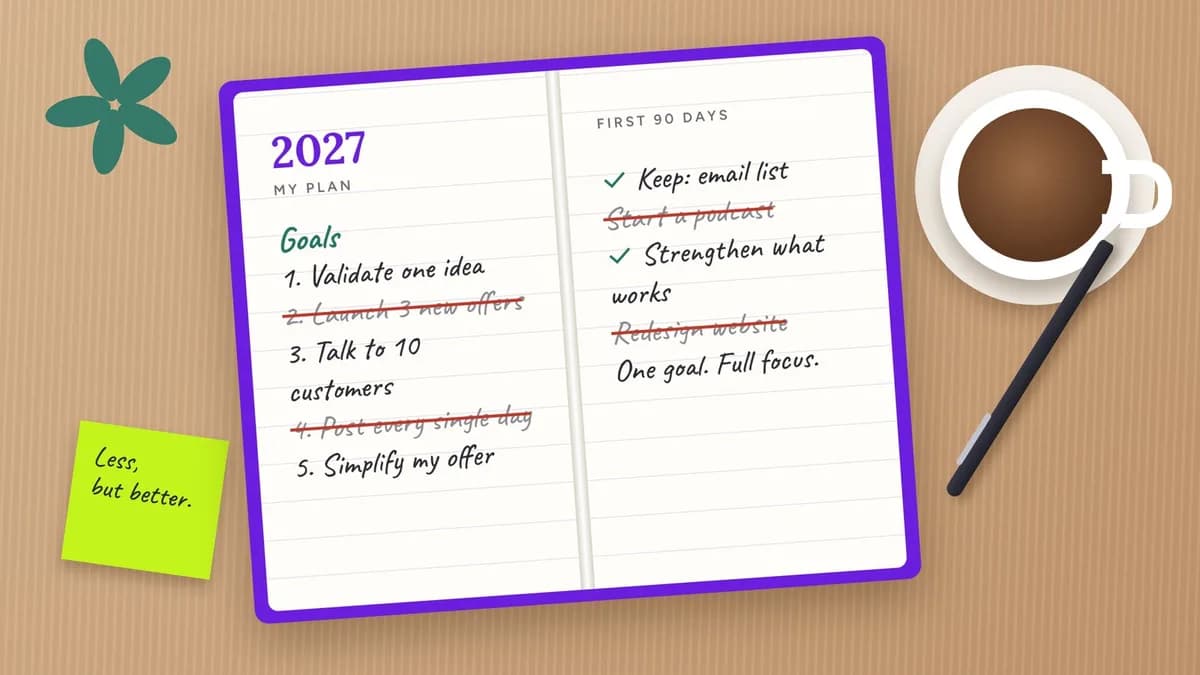
Before you start mapping out your goals for 2027, take another look at the plans you made for 2026.
The ideas you wanted to explore. The projects you started. The things you hoped to accomplish.
Some may have worked out beautifully. Others may have taken longer than expected, changed direction or simply stopped feeling important.
And that's worth paying attention to.
Because planning for a new year isn't just about deciding what you want to achieve next.
It's also about deciding what you're willing to let go of to make room for it.
Whether you're exploring a business idea, working toward your first sale or looking for ways to grow an established business, your time, money and attention are limited.
Every new commitment uses some of those resources.
So before adding more to your 2027 plan, here's a practical way to look at what deserves to stay, what could be simpler and what might be ready to go.
Stop Chasing Every Good Idea
A new business idea can be exciting.
So can a new product, marketing strategy, partnership or opportunity.
And with so much information available online, there's always another approach to consider.
But having several promising ideas doesn't mean you need to act on all of them.
The challenge is deciding which ones deserve your attention now.
One useful way to evaluate an idea is to look at three things:
- Relevance: Does this idea support the goal you're currently working toward?
- Evidence: What makes you believe there's a need or demand for it?
- Resources: What will it take to test or implement it?
For example, if you're considering starting an online business, you might have several ideas based on your skills and interests. Rather than building three different products, you could choose one idea and talk to potential customers to understand what they're looking for.
If you already have a business, the same principle applies to new offers, marketing channels and expansion opportunities.
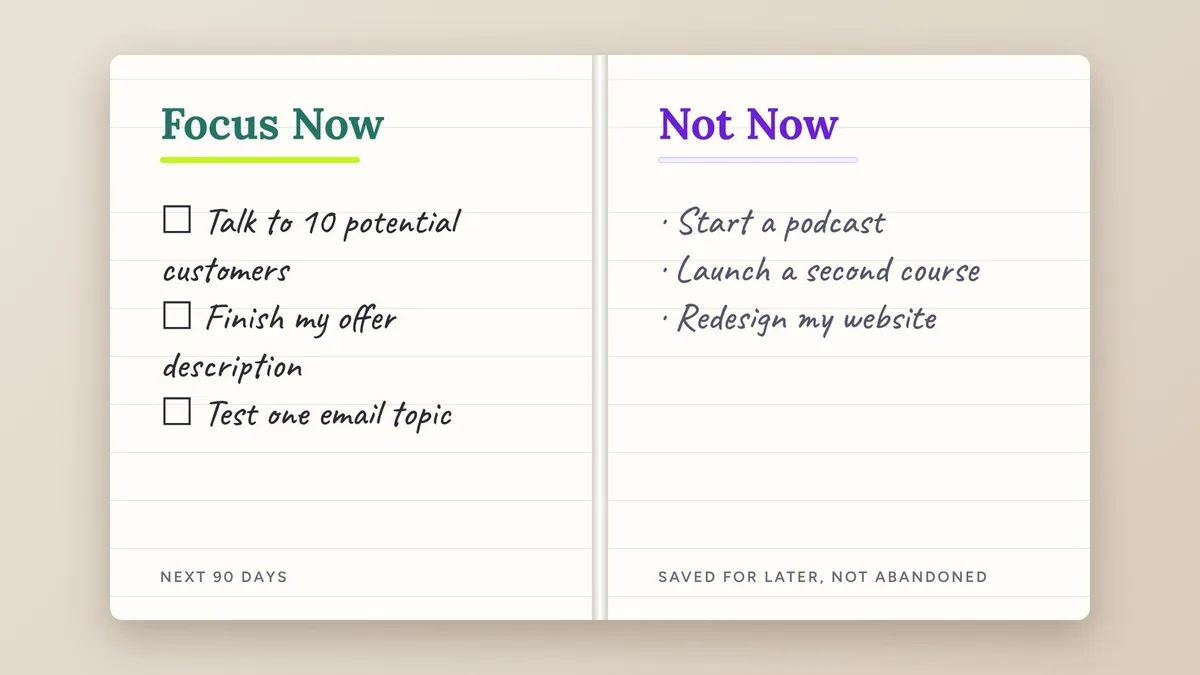
Try this: Create a "Not Now" list.
Write down ideas that interest you but aren't priorities for the next 90 days.
You're not abandoning them. You're giving yourself permission to focus on something else first.
Let Go of Marketing That Doesn't Have a Clear Purpose
Marketing can take many forms.
You might be posting on social media, sending emails, creating videos, attending networking events or experimenting with paid advertising.
Each approach can be useful, but they serve different purposes.
Some help people discover you. Others build relationships, generate leads or encourage sales.
The important thing is knowing what you want each activity to accomplish.
For example, if your goal is to validate a new business idea, having conversations with potential customers may give you more useful information than spending weeks creating social media content.
If you're selling an existing offer, you might focus on the channels that bring people to your sales page or generate inquiries.
And if you're building a community, engagement and meaningful conversations may be more relevant than immediate sales.
Try this: Choose one marketing activity and give it a clear goal for the next 30 days.
That could mean:
- Starting ten conversations with potential customers
- Testing a new email topic and reviewing the responses
- Tracking how many qualified inquiries come from a particular channel
- Comparing the time spent on an activity with the results it produces
At the end of the month, use what you've learned to decide whether to continue, adjust or stop.
You don't need to market everywhere. You need a reason for the marketing you're doing.
Simplify What You're Offering
Sometimes an offer becomes harder to explain as more features, options or bonuses are added.
The intention may be to make it more valuable.
But extra information can also make it harder for someone to understand what they're actually getting.
Consider a hypothetical example.
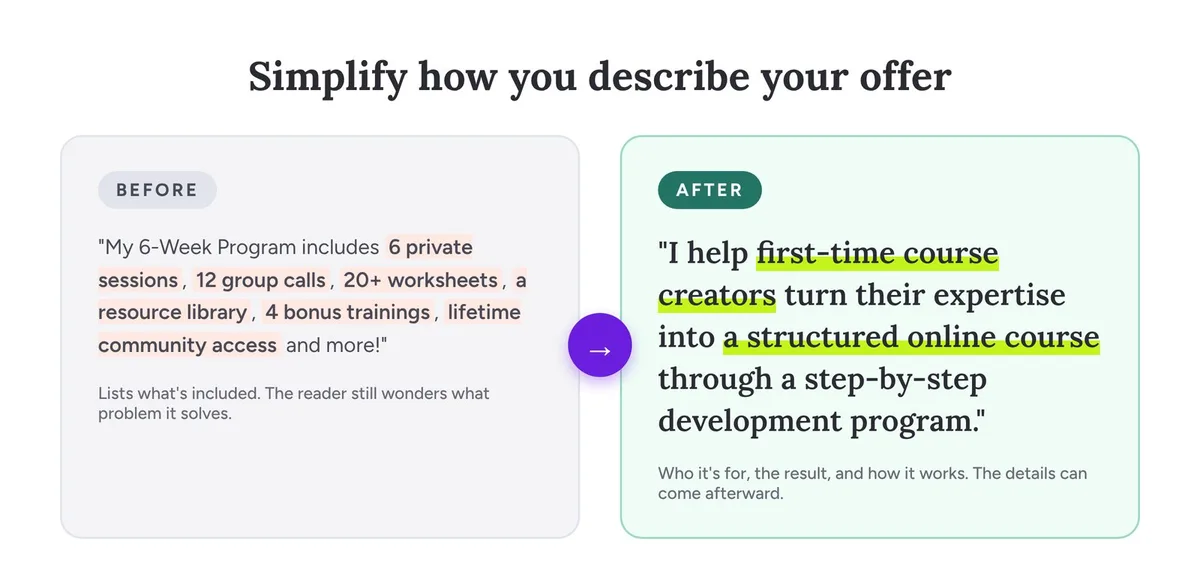
A coach offers a six-week program that includes private sessions, group calls, worksheets, a resource library, bonus trainings and access to an online community.
Those features may all be useful.
But if the description focuses entirely on what's included, a potential customer may still be unclear about the main problem the program helps solve.
A clearer explanation would start with who the program is for, what it helps them accomplish and how the experience works.
The details can come afterward.
Try this: Write a one-sentence description of your business idea, product or service using this structure:
I help [specific audience] achieve [specific result] through [your approach].
For example:
"I help first-time course creators turn their expertise into a structured online course through a step-by-step development program."
This isn't a formula you have to use in every marketing message. It's a way to check whether your offer is easy to understand.
If you haven't created an offer yet, use the exercise to clarify your idea before building it.
If you already have products or services, compare the sentence with how you currently describe them.
You may discover opportunities to simplify your messaging, your delivery or both.
Reconsider Projects You've Outgrown
Starting something doesn't mean you're obligated to finish it exactly as planned.
Imagine you've spent several weeks developing a course, website or new business concept.
Then you learn something that changes your original assumptions.
Maybe customer conversations reveal a different need.
Maybe the project requires more resources than expected.
Or perhaps another opportunity now makes more sense.
Continuing simply because you've already invested time or money can lead to what psychologists call the sunk cost fallacy.
That's when past investment influences a decision even though those resources can't be recovered.
A better approach is to evaluate what it would take to continue from today.
Try this: Give each unfinished project one of four decisions:
- Continue: The project still supports your goals and the remaining investment makes sense.
- Simplify: A smaller version could deliver the most important value.
- Pause: The idea has potential but isn't a priority right now.
- Stop: The resources required would be better used elsewhere.
For example, instead of finishing a complete online course before testing demand, you might offer a small live workshop on the topic first.
That gives you an opportunity to learn from real participants before investing in a larger product.
Changing your approach doesn't erase the work you've already done. It allows you to use what you've learned to make a better decision.
Make Room for the Goals That Matter Most
It's possible to have several goals that are all worthwhile.
But pursuing them at the same time can divide your resources across too many priorities.
That's why a useful business plan needs more than a list of things you want to accomplish.
It also needs a realistic view of what you can commit to.
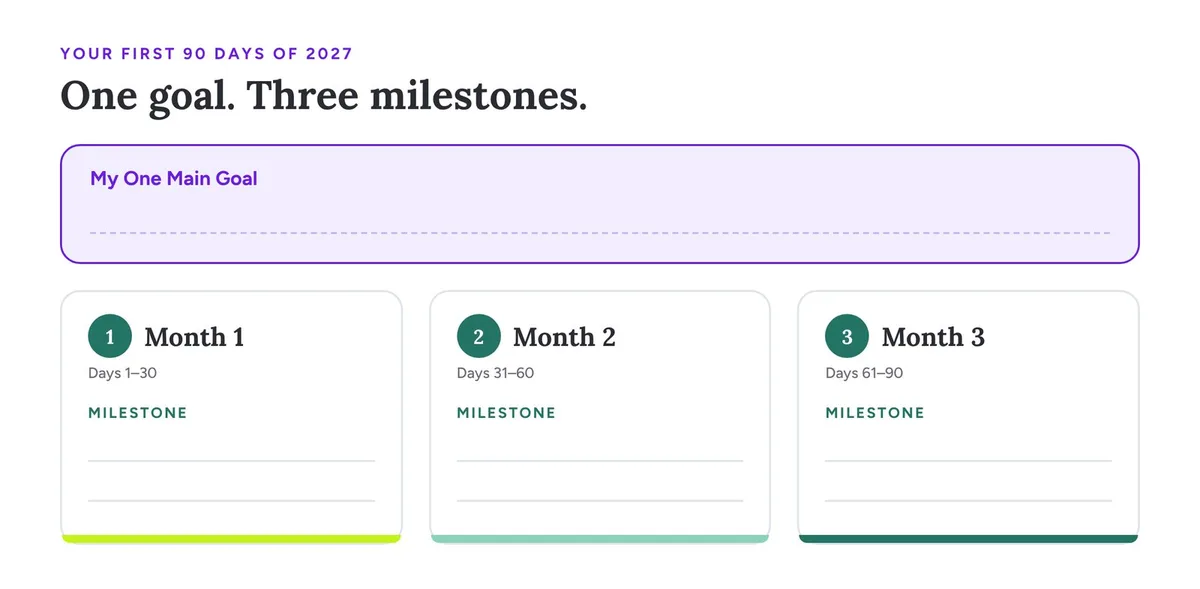
Start by choosing one primary goal for the first 90 days of 2027.
It might be validating a business idea, making your first sale, improving an existing offer, increasing customer retention or strengthening your business systems.
Then identify the activities most directly connected to that goal.
For example, if your priority is validating a business idea, your first 90 days might include:
- Month 1: Research your audience and speak with potential customers.
- Month 2: Develop a simple offer based on what you've learned.
- Month 3: Test the offer, gather feedback and decide what to improve.
For an established business, the same 90-day structure could be used to improve an existing product, test a marketing strategy or streamline a process.
The activities will differ, but the principle stays the same.
Give your most important goal enough time and attention to make meaningful progress.
The Stop, Simplify, Strengthen Exercise
Here's a way to bring everything together before planning your next year.
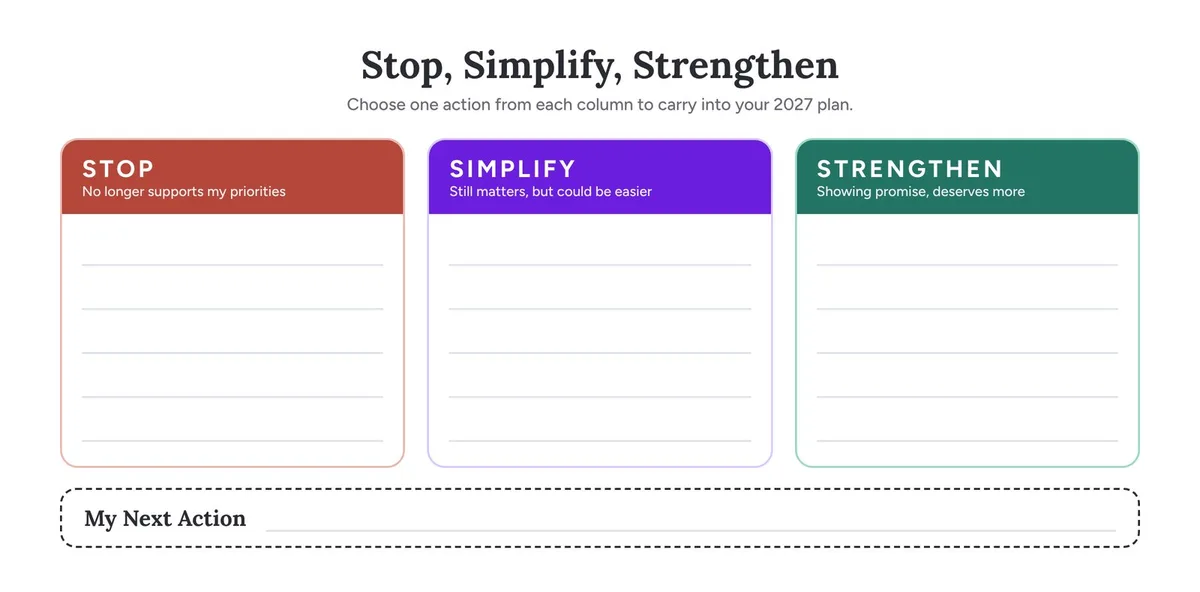
Take a sheet of paper and divide it into three columns.
STOP: Activities, projects or commitments that no longer support your priorities.
SIMPLIFY: Things that still matter but could be done with fewer steps, less complexity or a clearer approach.
STRENGTHEN: Ideas, activities or relationships that are already showing promise and deserve more attention.
Here's an example of what that might look like:
| STOP | SIMPLIFY | STRENGTHEN |
|---|---|---|
| Posting daily on a platform that hasn't brought in a single inquiry | Cut my offer description down to one clear sentence | Customer conversations, which gave me my best ideas this year |
| Building a second course before the first one has sold | Turn a 12-module course idea into a 90-minute live workshop | The email list, which is where my sales actually came from |
Your list will look different depending on where you are in your business journey.
Once you've completed it, choose one action from each column.
Set a date for what you'll stop, identify the first step toward simplifying something and decide how you'll invest more attention in what you want to strengthen.
This gives you three concrete decisions to carry into your 2027 plan.
A Fresh Start Doesn't Have to Mean Starting Over
There's something appealing about a new year.
A fresh calendar. New possibilities. The chance to approach things differently.
But you don't have to replace everything you've been doing to make progress.
Some ideas deserve more time.
Some plans need adjusting.
And some commitments may no longer be worth carrying forward.
The purpose of looking back at 2026 isn't to judge everything you did or didn't accomplish.
It's to use what you've learned to make more intentional choices about what comes next.
I'd love to hear from you in the comments:
What's ONE thing you're considering stopping, simplifying or strengthening in 2027?
Ready to Turn Your Expertise Into Income FASTER?
One way to simplify your business strategy is to get clearer about exactly who you serve and what you offer them.
Take my $9 Profitable Micro-Niches Mini-Course!
You know the riches are in the niches... But most people's niches are too broad. They're missing that critical Market Fit.
And that's exactly what your Micro-Niche is all about...
Defining exactly what you do AND exactly who you serve in such a specific, compelling way leaves your Perfect Customers no choice but to lean in and say... how can I get what you've got?!
I'll show you how to find yours in my $9 Mini-Course!
