
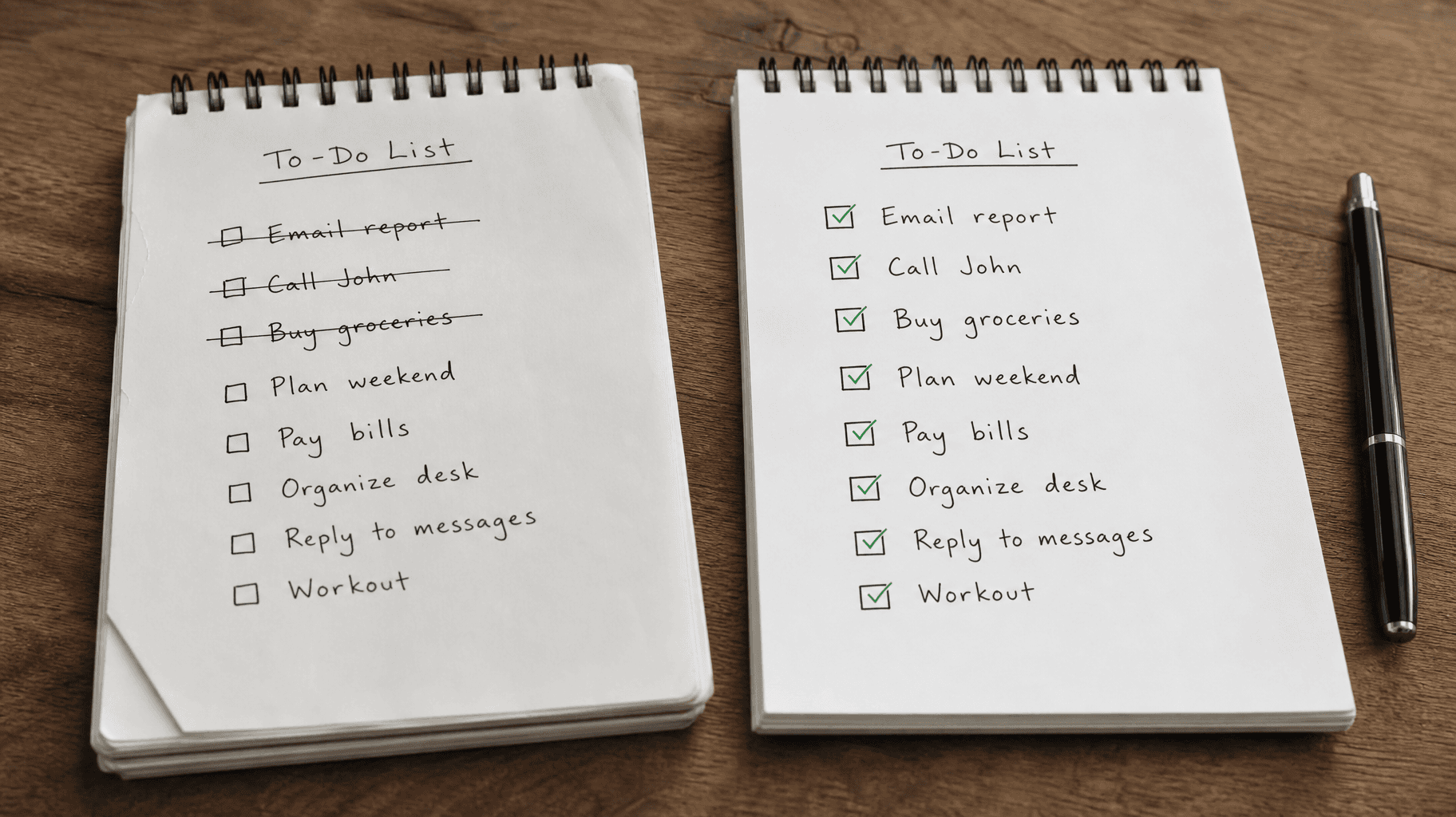
You know the feeling. You start strong. You’ve got the plan, the notebook, the fresh motivation… and somewhere around week two, it quietly falls apart.
Maybe it’s the course you were supposed to finish. The content calendar you swore you’d stick to. The business plan that’s still sitting in a Google Doc, three tabs deep, untouched since January.
And when it falls apart, most of us do the same thing: we blame ourselves. “I just don’t have the discipline.” “I’m not a finisher.” “I need to want it more.”
Here’s the thing — that story is wrong. Willpower was never the variable that mattered. What actually determines whether people finish anything has almost nothing to do with how badly they want it, and almost everything to do with what’s built around them while they’re doing it.
Willpower Is a Terrible Long-Term Strategy
Willpower is a finite resource. It gets used up making decisions, resisting distractions and pushing through discomfort — all day, every day. By the time you sit down to work on the thing you actually care about, you’re often already running on empty.
That’s not a character flaw. That’s just how humans work. And it’s why relying on “just push through it” as your entire completion strategy sets you up to fail before you’ve even started.
The people who consistently finish things — courses, launches, habits, goals — aren’t the ones with more grit. They’re the ones who stopped depending on grit in the first place.
What Actually Predicts Completion
If discipline isn’t the answer, what is? The research on behavior change points to the same conclusion over and over: structure beats intention. Environment beats effort. The system you build around a behavior matters more than how motivated you feel when you sit down to do it.
In other words — the people who finish didn’t get better at forcing themselves. They got better at removing the moments where forcing themselves was required at all.
I saw this play out firsthand years ago when I was running one of our live events. We added something simple — a Star Chart. Every session had one or two small Wins built in, like “Outlined My Webinar” or “Invited a Joint Venture Partner.” At the end of each session, we’d hold it up and everyone added a gold star for what they’d completed.
It sounds almost too simple to work. But once people started collecting stars, they couldn’t stop. There’s a well-documented psychological principle behind it — once we take action in a direction, we feel compelled to stay consistent with it. Completion breeds completion. The Star Chart didn’t make anyone more disciplined. It just gave their existing effort somewhere visible to go.

Why Most Courses (and Plans) Don’t Get Finished
This shows up constantly in course creation. Most courses are built like information dumps — module after module, video after video, all under the assumption that more content equals more value.
Industry numbers on this are rough almost everywhere you look: a large share of students who start a self-paced course never finish it. And when they don’t, they usually blame themselves. “I guess I’m just not disciplined enough.”
But it was never about their discipline. It was about design. A course with no built-in structure — no checkpoints, no small wins, no clear next step — is asking every single student to supply their own willpower, indefinitely, with nothing external holding them up along the way.
The fix isn’t a pep talk. It’s redesigning the experience so finishing is the path of least resistance, not a feat of personal strength.
The External Structure That Actually Works
If you want more follow-through — in your own work or in what you’re building for your students and customers — here’s where to focus instead of white-knuckling your way through:
• Break the big thing into small, visible wins. A goal that only pays off at the finish line gives your brain nothing to hold onto along the way. Small, trackable progress keeps momentum alive.
• Build in accountability that isn’t just you. A deadline you set for yourself is easy to move. A deadline shared with someone else — a coach, a peer, a community — is much harder to quietly abandon.
• Design the environment, not just the intention. Remove friction before it shows up. Put the notebook on your desk the night before. Block the time on the calendar instead of hoping you’ll “find” it.
• Create a cue that starts the behavior automatically. A morning routine, a shutdown ritual, a consistent time slot — anything that removes the daily decision of “should I do this right now” makes follow-through far more likely.
None of these require more discipline. They require better design — which is actually good news, because design is something you can build once and lean on forever.
What This Means for Your Business
If you’re building anything that requires follow-through from other people — a course, a challenge, a program — this is the lens worth applying. Don’t ask “how do I get my students more motivated?” Ask “what am I asking them to do with zero support, and how do I build structure around that instead?”
And if you’re the one struggling to finish your own projects, the same question applies to you. The plan that’s been sitting untouched for weeks doesn’t need more willpower thrown at it. It needs smaller steps, a visible way to track progress and someone or something outside your own head keeping you honest.
Finishing was never about wanting it enough. It’s about building a structure that doesn’t require you to want it every single day.
What’s one thing you’ve been trying to “push through” with willpower that might actually need a structural fix instead? I’d love to hear it in the comments.
Speaking of getting specific…
Turn your expertise into income FASTER! Take my $9 Profitable Micro-Niches Mini-Course!
You know the riches are in the niches… but most people’s niches are too broad — they’re missing that critical Market Fit. And that’s exactly what your Micro-Niche is all about.
Defining exactly what you do AND exactly who you serve in such a specific, compelling way leaves your Perfect Customers no choice but to lean in and say… how can I get what you’ve got?!
I’ll show you how to find yours in my $9 Mini-Course!
